Disconnected decisions
Teams, vendors, and platforms move in parallel without a shared architecture or accountable system owner.
Enterprise systems
Magnivara architects connected digital systems for organizations where governance, adoption, security, and scale cannot be afterthoughts.

The pressure
The hard part is rarely a single interface or platform. It is aligning the system around the people, controls, data, and decisions that make change durable.
Teams, vendors, and platforms move in parallel without a shared architecture or accountable system owner.
Security, permissions, data policy, and change management become approval gates instead of design inputs.
A delivered tool creates little value when workflows, enablement, governance, and operating rhythms remain unresolved.
Systems architecture
We establish the boundaries, interfaces, decision rights, and delivery logic that keep an enterprise system coherent as it evolves.
Role-aware journeys, usable workflows, and consistent interaction patterns across every critical touchpoint.
Process logic, approvals, handoffs, and exception paths mapped into an accountable operating model.
Stable contracts between platforms, data domains, identity, automation, and the systems that must remain.
Ownership, access, lifecycle controls, and observability embedded into the architecture from the outset.
Governance by design
Enterprise readiness is not a final review. We make governance and security visible in the system model, the delivery plan, and day-to-day ownership.
Role boundaries, permission models, identity dependencies, and escalation paths defined before build.
Clear ownership, handling rules, system-of-record decisions, and retention expectations across flows.
Threats, failure modes, exceptions, and approval requirements translated into practical controls.
Monitoring, incident ownership, release discipline, and change governance designed for the live system.
Phased implementation
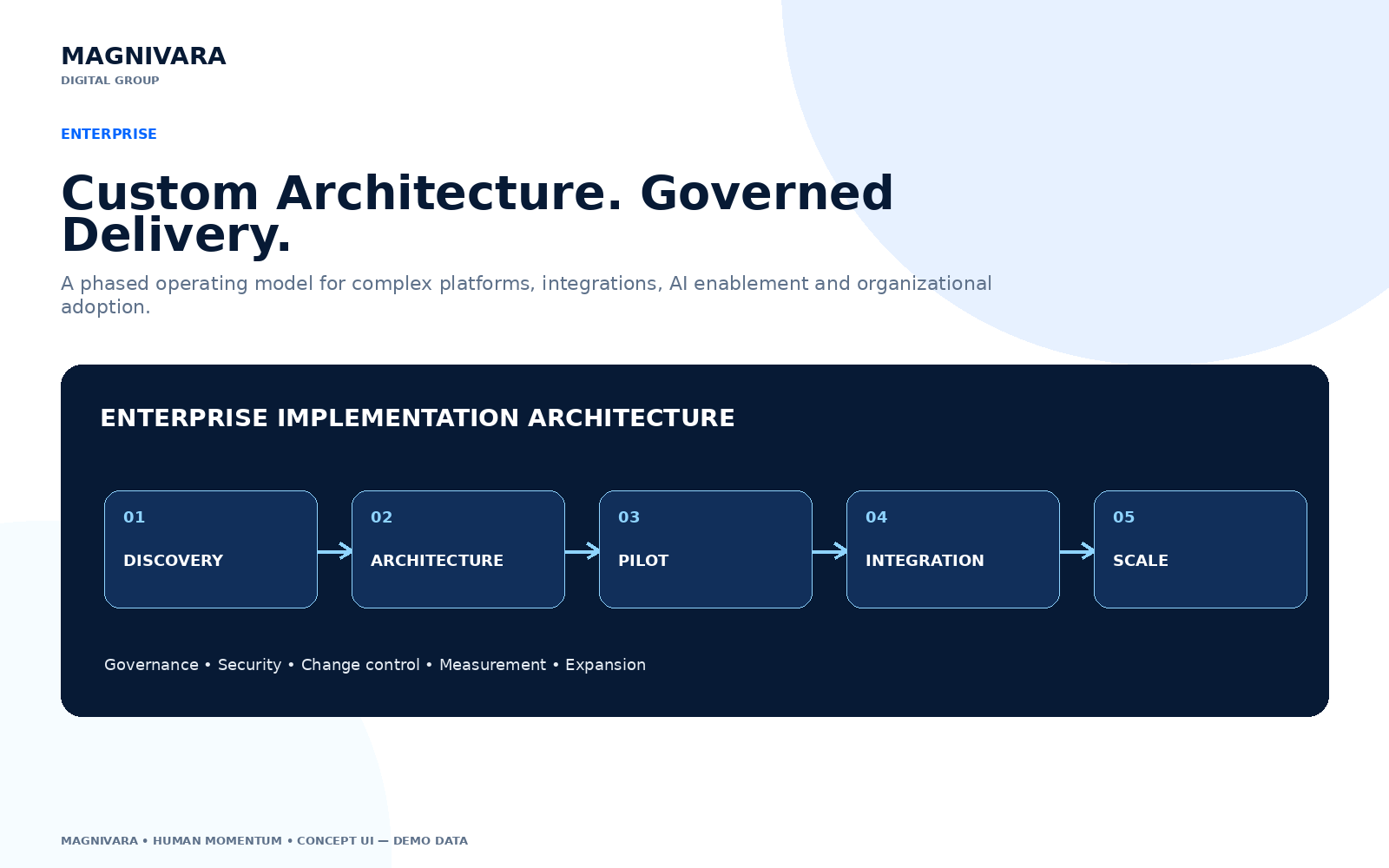
A staged path reduces uncertainty while preserving the architecture. Each phase ends with a concrete decision, usable output, and an informed next step.
Integration strategy
We design around the real technology estate—not an imaginary clean slate—so new capability can coexist with essential platforms and processes.
Clarify what each platform owns, where duplication ends, and which dependencies are strategic.
Define schemas, triggers, validation, and failure handling so integrations remain legible and resilient.
Map authentication and authorization into the experience without weakening enterprise controls.
Automate repeatable decisions with visible rules, exceptions, handoffs, and accountable owners.
Expose system health, integration failures, and service conditions to the teams responsible for action.
Create a migration and deprecation path that limits disruption while reducing long-term complexity.
Scale with control
Scalable systems make room for more teams, regions, workflows, and integrations while keeping standards and ownership intact.

How we engage
Magnivara works as a compact systems studio: close to leadership, useful to delivery teams, and accountable for turning complexity into forward motion.
Establish the business outcome, non-negotiables, sponsorship, and decision cadence.
Work directly with operators, technical owners, security, and users to understand the actual system.
Produce architecture, service models, prototypes, and roadmaps that teams can use—not shelfware.
Build internal clarity and ownership so the system can evolve after the engagement.
Where we fit
The strongest engagements have an important outcome, cross-functional complexity, executive sponsorship, and a willingness to resolve the operating model—not only the interface.
Start with the system
We can begin with the decision in front of you—then determine the smallest responsible engagement to create clarity and momentum.