Business context
Priorities, constraints, decision owners, and the outcomes that matter most.
Our approach
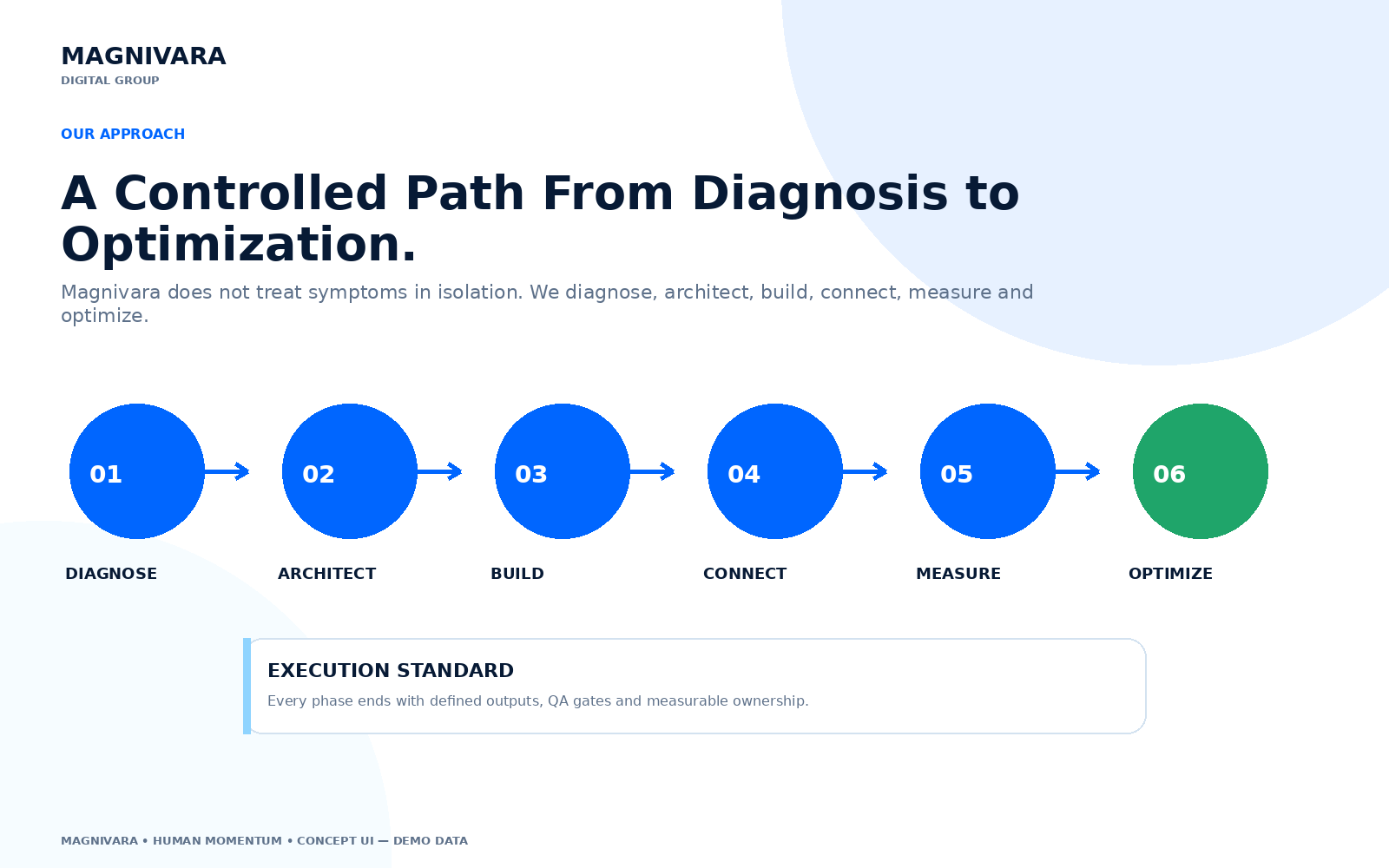
We move from evidence to architecture, then from implementation to continuous improvement—so every layer of your digital operation works as one deliberate system.
Diagnose · Architect · Build · Connect · Measure · Optimize

Stage 01 · Diagnose
Before recommending a platform or designing a workflow, we map the operating reality: what works, what breaks, what is missing, and what the business needs next.
Priorities, constraints, decision owners, and the outcomes that matter most.
The paths customers and team members take across channels and systems.
Platforms, data movement, manual work, risks, and integration dependencies.
Journeys, interfaces, content, and moments of human decision.
Platforms, data ownership, logic, integrations, and controls.
Phases, responsibilities, acceptance gates, and change management.
Stage 02 · Architect
The blueprint aligns customer experience, operations, data, and governance. Every component earns its place by supporting the larger system.

Stage 03 · Build
Implementation follows the architecture in focused increments. Each release is checked for quality, usability, responsiveness, accessibility, and fit with the operating model.
01
Make the essential flow tangible before expanding its footprint.
02
Check the experience against the blueprint and real operating needs.
03
Move approved increments forward with ownership and handoffs defined.
Connected operating flow

Stage 04 · Connect
Connections are designed around business events and accountable handoffs. That keeps data useful, reduces repeated work, and makes the customer journey easier to follow.

Stage 05 · Measure
Measurement is designed around decisions, not dashboard volume. We define the signals that reveal journey friction, adoption, system health, and the quality of handoffs.
Choose evidence tied to a real operating question.
Keep definitions, ownership, and source limits visible.
Connect every view to the action it should inform.
Review real behavior, exceptions, and adoption patterns.
Choose refinements by operating value and effort.
Release, document, and measure the next iteration.

Stage 06 · Optimize
A launch is a transition, not a finish line. Improvement rhythms keep the system useful as behavior, priorities, and technology change.
Execution standards + QA gates
Each stage closes with a visible decision gate. That keeps incomplete assumptions from becoming expensive downstream dependencies.
Scope, requirements, responsibilities, and acceptance criteria are explicit.
Experience, responsiveness, accessibility, content, and system behavior are checked.
Dependencies, documentation, ownership, and release conditions are understood.

A shared operating rhythm
The work moves best when decisions, inputs, and ownership stay visible on both sides.
Magnivara delivers
Client responsibilities
Build from clarity
Start with the operating reality. Then build the connected experience, architecture, and improvement rhythm that can move with you.