Fewer handoff gaps
Route routine work clearly while keeping exceptions visible.
 Automation systems
Magnivara designs connected automation systems that reduce repetitive work, accelerate response, and keep the right people in control.
We begin with the real operating sequence: where work enters, who owns the next decision, which actions repeat, and where judgment still matters. The result is a system your team can understand, operate, and improve.
Route routine work clearly while keeping exceptions visible.
Trigger timely actions from reliable signals and defined ownership.
Make the flow inspectable instead of hiding it inside disconnected tools.
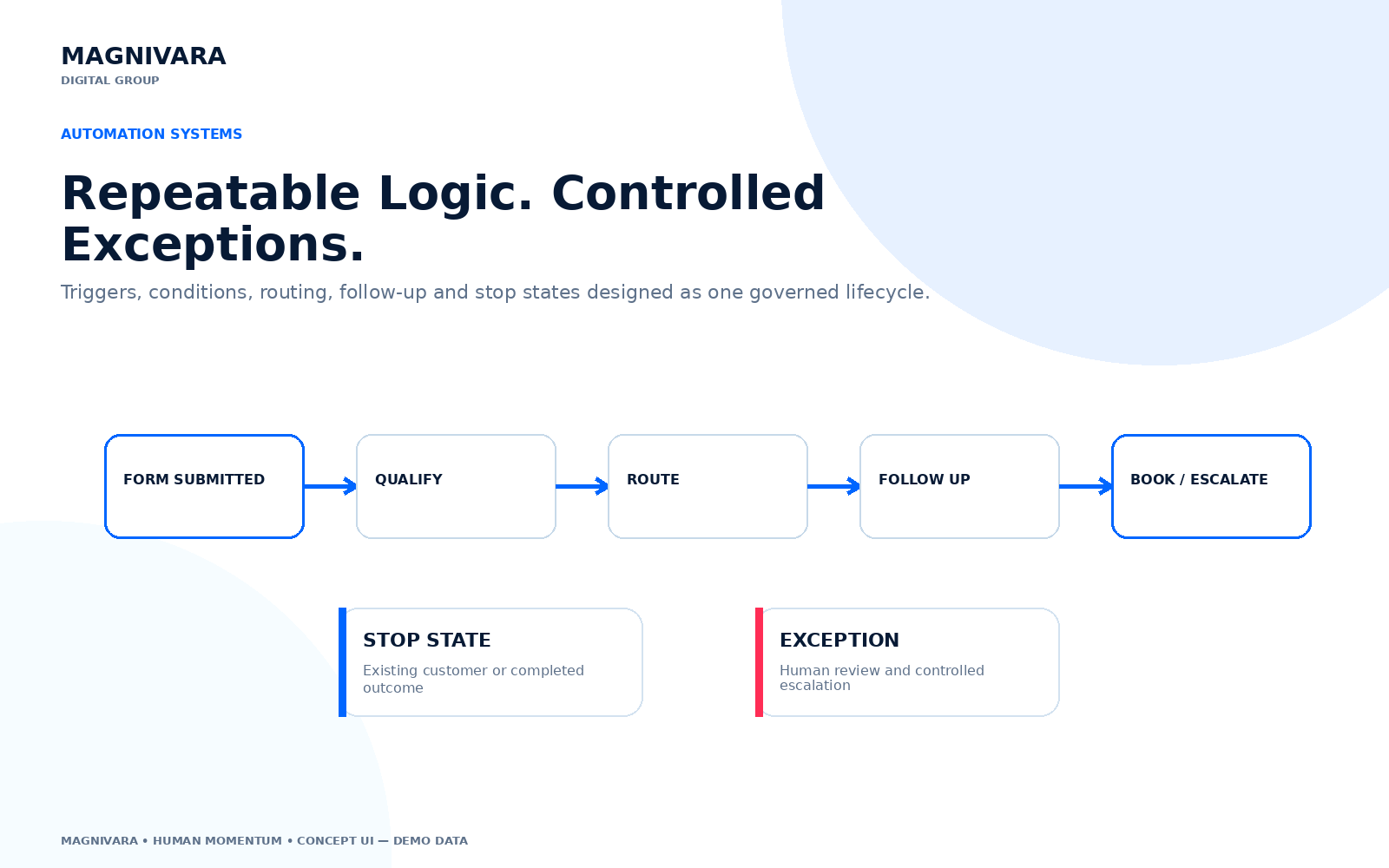
The architecture graphic shows how signals, decisions, actions, and human review work as one operating sequence.
Classify, assign, notify, and escalate according to explicit operating rules.

Connect the interfaces teams already depend on without creating hidden duplication.
Coordinate timely follow-up moments while preserving human judgment and brand tone.
Move work between roles with clear ownership, context, and exception paths.
Magnivara pairs automation with explicit review points, fallback paths, and visible system states. Teams know what happened, why it happened, and when a person should step in.
A qualified event enters the system.
Conditions determine the next safe action.
Exceptions remain visible and owned.
Document the current flow, owners, inputs, and failure points.
Define triggers, conditions, actions, exceptions, and controls.
Implement the smallest reliable system and validate each handoff.
Review performance and refine the operating logic over time.
Recurring manual work, inconsistent follow-up, fragmented handoffs, or multiple tools that should operate as one system.
We identify the highest-leverage operating constraint and determine whether automation is the right intervention.
Map the operating constraint, define the decision logic, and identify the right first intervention.